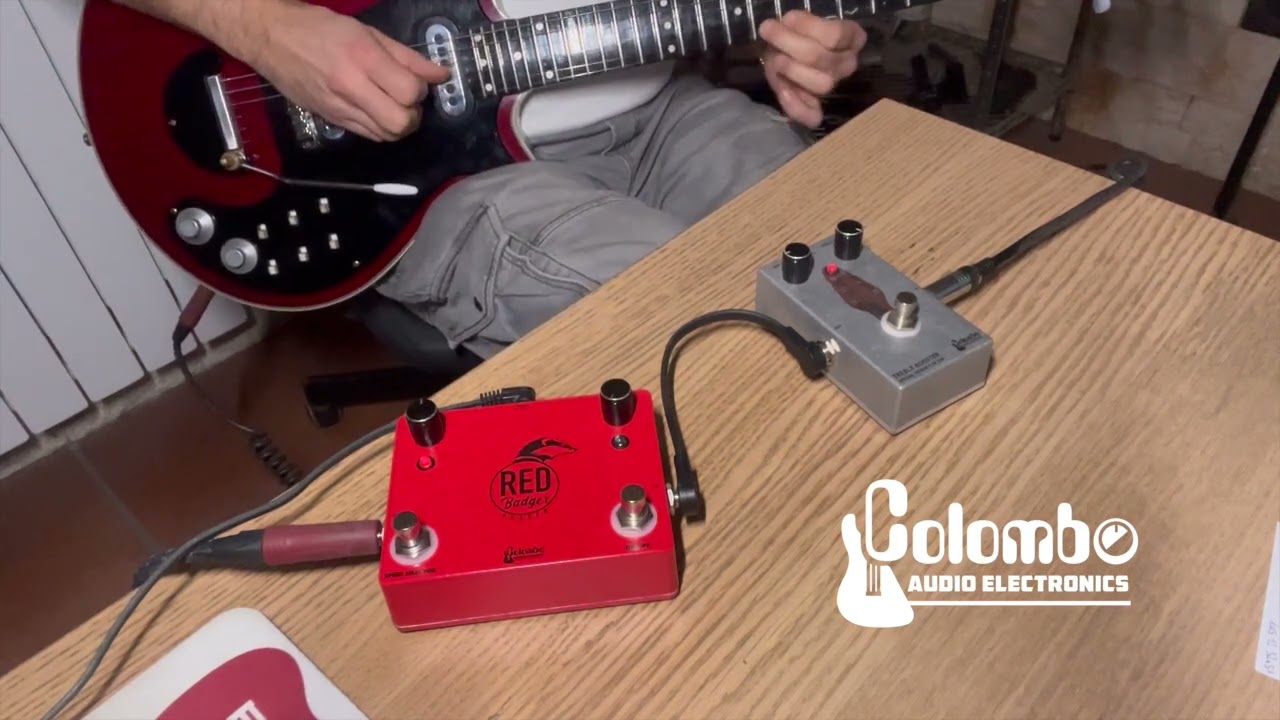
The Red Badger Phaser
Undeniably inspired by the fOXX, the Red Badger isn’t intended to be a clone; several copies of the original exist on the market with convincing results. With the Red Badger, we wanted to recreate the same phasing sound as the fOXX, solving some small issues and adapting the circuitry to be used as a classic guitar pedal, compatible with any pedalboard.
The input stage of the fOXX Footphaser is designed to receive a signal with a lower impedance than the guitar, and the first gain stage, not being configured as a buffer, can cause annoying interference if used with a treble booster in front. In the Red Badger, the solution was to maintain the phasing behavior unchanged, resulting in a much more linear guitar-effect matching. The fOXX’s output stage was also not designed to be connected to a guitar amplifier, resulting in a very annoying pop (or bang) every time we activate or deactivate the Phaser. The Red Badger uses a PNP output stage to address this and other issues with the output stage.
The concept of the Red Badger, from a layout perspective, was also to make it user-friendly without sacrificing the functionality of the original fOXX Footphaser: continuous control over the fOXX certainly offered greater expressive possibilities by being able to control its speed in real time, but it also required surgical precision with the foot on the treadle to achieve the desired speed. So we decided to create the Red Badger with two different modes, each with the same sound, and both can be selected via a dedicated footswitch. This allows you to always have two modes at your fingertips without having to calibrate anything.
Speed A (Standard mode): When the pedal is set in this mode, phase speed control is complete; the speed can be adjusted from extremely slow to extremely fast, much like other standard MXR-style phaser pedals (we’re only talking about LFO speed, not sound).
Speed B (Custom mode): This is very similar to the treadle travel of a fOXX set to slow (Brian May’s favorite). When set to minimum, it’s like having the treadle at minimum on the fOXX, and when set to maximum, you don’t reach the extreme speeds of the Standard mode, but you’re still within the range of the fOXX’s slow position.
These features were introduced to make the Red Badger highly versatile and adaptable to any type of use: two distinct speeds; a more traditional and a more aggressive phasing; the ability to simulate a treadle, and much more. No need to calibrate anything.
Why devote so much time and attention to an effect from another era? Luca Colombo shares his thoughts.
“As a Queen music enthusiast and a fan of Brian May, I’m not the only one considering the guitar sound of the late ’70s concerts the most majestic, regal, and aggressive in the entire history of Queen and Brian May. For years, I thought it was exclusively due to the particularly successful Vox AC30 series used in those years. That’s probably true, but I never paid particular attention to the effect that undoubtedly contributed to the creation of those sounds: PHASER. A Phaser used before a saturated amplifier —as it should be used— not only creates the typical cyclic effect, characteristic of LFO-based devices, but adds depth and sustain, contributing to a more massive sound. Therefore, I wanted to undertake this sonic, technical, and musical research, seeking to improve a device conceived, nowadays in 2025, over half a century ago, while maintaining its flavor and timeless characteristics.”
The controls
Speed A: Sets the speed for Standard mode;
Speed B: Sets the speed for Custom mode.